Content note: this piece discusses the deaths of children.
In Euripides’ Medea, Jason leaves Medea to marry another woman. Medea is devastated and furious. She kills their two sons, knowing that their deaths will wound Jason in a way nothing else could.
It is a story that has unsettled audiences for centuries. We can understand that Medea has been betrayed without making the children’s deaths understandable or acceptable. The children are not simply part of a conflict between adults. They have their own place in the story.
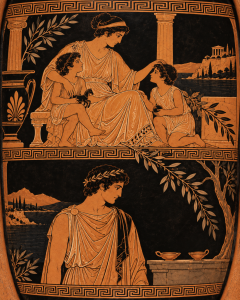
There is another chapter to Medea’s myth. After leaving Corinth, she goes to Athens. In one account, she has another son there, Medus.
He was born later. He did not survive the deaths of his older brothers, because he was not yet one of the children in that household. But imagine growing up and learning what people say about your mother. Imagine trying to find your place in a family story that began before you were born.
If Medus came to a family constellation, I wonder where we would begin.
Perhaps with him standing in his own place. Perhaps with space to acknowledge his brothers as children who lived and died, rather than as a terrible fact about his mother. He might have questions about Medea. He might feel love, anger, fear, loyalty, or things for which he has no words. We could not know in advance.
A constellation would not need to settle what Medus ought to feel. It might offer a way to distinguish his life from what happened before it, while allowing his brothers to belong to the family story.
I have been thinking about this ancient tale while following the case of Lindsay Clancy, the American mother charged in the deaths of her three children. Her trial ended in a mistrial after the jury was unable to reach a unanimous verdict. At the time of writing, it remains undecided whether she will face another trial. Her defence raised issues concerning her mental health and criminal responsibility; those are matters for the evidence and the court, not for an ancient myth to answer.
The children were Cora, Dawson and Callan. Whatever is eventually decided about criminal responsibility, their lives and deaths must not disappear behind arguments about their mother.
Medea cannot tell us why a real woman’s children died. Nor can a family constellation conducted in our imaginations tell us anything about a family we do not know.
What the myth can do is make me pause over whose place is visible in a story. When attention gathers around a mother’s actions, can we still see each child as a person? Can we recognise grief without assigning feelings to surviving relatives? Can we stay with questions that have no simple answer?
For Medus, in this imagined constellation, I would hope for one modest possibility: that he could know the truth of his family story without being required to carry all of it as his own identity.
Medus’s imagined constellation is a reflection on the myth, not an account of a real therapeutic session or an interpretation of the Clancy family.