Reflections on Mercury in Virgo, creativity and the language beyond words
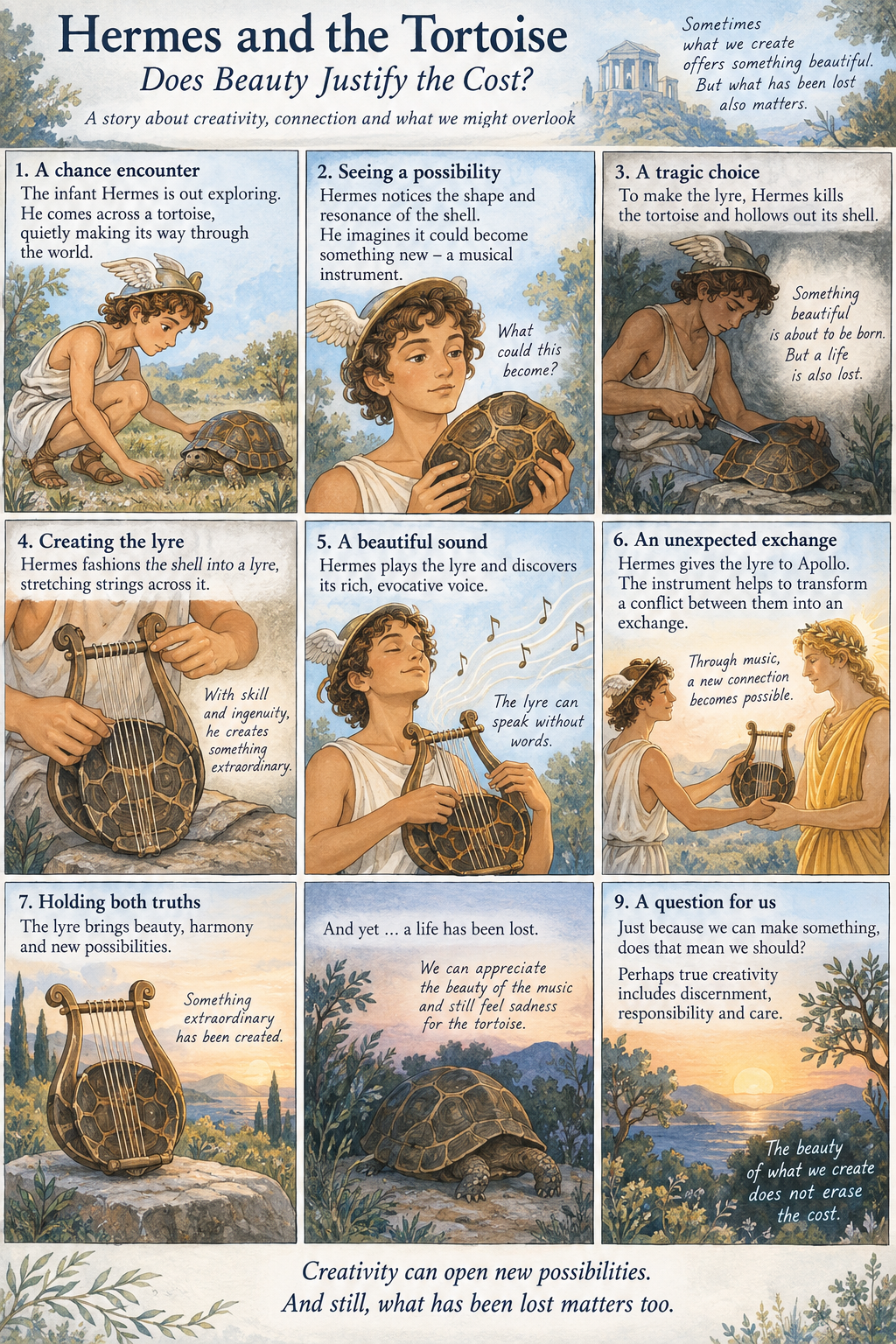
In Greek mythology, the infant Hermes encounters a tortoise.
He recognises something extraordinary in its shell. He kills the creature, hollows out its shell and fashions it into a lyre.
From something that was once alive, he creates an instrument capable of producing beautiful music.
I have been thinking about this story while exploring why Mercury is traditionally considered exalted in Virgo.
Mercury is associated with intelligence, ingenuity, communication and invention. Virgo brings to mind craftsmanship, precision and the ability to work skilfully with the materials available.
Hermes demonstrates these qualities beautifully.
He sees possibilities where others might see nothing. He takes an ordinary creature and creates something entirely new.
But I find myself troubled by the tortoise.
Hermes doesn’t simply find an empty shell. He kills the creature to obtain it.
His ingenuity is remarkable, but he appears remarkably unconcerned about the life he has taken.
Would I feel differently if he had discovered an already-dead tortoise and transformed its shell into an instrument?
Absolutely.
I could then appreciate the transformation without feeling troubled by its origins.
This raises a question about intelligence and creativity.
Just because we can make something, does that mean we should?
Perhaps craftsmanship requires more than the ability to recognise potential. Perhaps it also requires discernment about what we use and what we might destroy in the process.
And perhaps this is a question worth considering when exploring Mercury’s exaltation in Virgo.
Not simply: What can I create?
But: What is the cost of creating it?
When words are no longer enough
There is another aspect of this myth that fascinates me.
Hermes is the god of communication, language and messages. Yet he creates an instrument that communicates without words.
The lyre eventually passes to Apollo, the god associated with music, prophecy and harmony.
Music can express something that language sometimes cannot.
As an attachment-based psychotherapist and family constellations facilitator, I am particularly interested in the ways we communicate beyond speech.
In family constellations, we pay attention to what participants experience and express through their bodies.
A movement, a change in posture, a sensation or a moment of silence may offer something to explore that has not yet found its way into words.
These experiences are not necessarily evidence of hidden truths about a family. They are opportunities for reflection and enquiry.
Sometimes we can talk incessantly about something without getting any closer to experiencing it.
At other times, music, movement or silence may allow a different kind of communication.
Perhaps one of the most interesting things about Hermes is that the god of language creates something that allows us to move beyond language.
His intelligence produces an instrument through which something else can speak.
But what about the tortoise?
I keep returning to the creature whose life was taken.
It would be easy to turn this story into a celebration of transformation: death becomes music, something ordinary becomes extraordinary, and beauty emerges from destruction.
But that interpretation feels incomplete to me.
The tortoise did not choose to become a lyre.
Its death was not simply an unfortunate event that Hermes transformed into something meaningful. Hermes caused it.
I can admire the ingenuity of the invention without admiring the act that made it possible.
Perhaps the story asks us to hold these two responses together.
Intelligence can be extraordinary without necessarily being compassionate.
Creativity can produce beauty without justifying everything involved in its creation.
And transformation does not erase what has been lost.
This distinction feels important in therapeutic work, too.
We may discover meaning, creativity or new possibilities following painful experiences. But that does not mean the original suffering was necessary, deserved or justified.
We do not need to celebrate the wound in order to recognise what someone has made of their life afterwards.
I began exploring this myth because I wanted to understand Mercury’s exaltation in Virgo.
I was fascinated by Hermes’s ability to make something from almost anything.
But the more I considered the story, the more interested I became in the creature he used.
Perhaps that is where I want to leave the question.
The beauty of the music does not erase the death of the tortoise.